Improving waste management services to deliver a significant carbon benefit
Region, Route & Location: Southern Region | Managed Stations | Depots and other sites
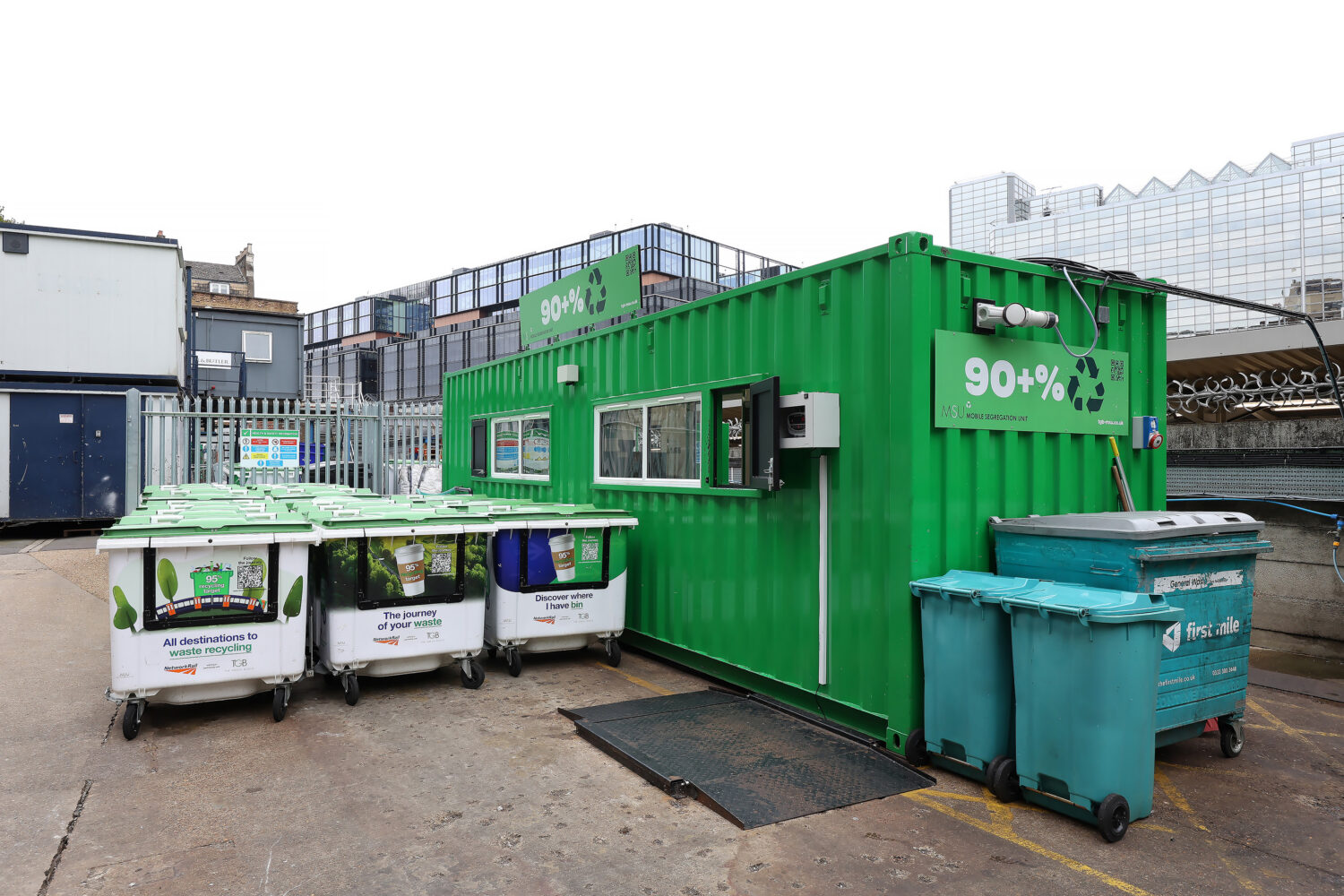
Network Rail Southern Region operates seven of the 20 managed stations in Britain, through which tens of millions of passengers travel each year. Across these stations, tonnes of waste is generated each month by passengers and retailers.
Since 2020, we have upgraded our waste management approach by adopting The Green Block’s patented Mobile Segregation Unit (MSU). The MSU enables waste collected from trains, public bins, and station retailers to be manually segregated on‑site into recyclable materials, improving recovery rates and material quality.
At each hub, materials such as aluminium cans, cardboard, paper and glass are separated into individual recycling streams. Completing this segregation on‑site increases the value of recyclable materials and significantly improves the likelihood that they are recycled correctly. This approach maximises both sustainability and commercial benefits.
Examples of improvements delivered through the MSU approach include:
- Targeted education and engagement with our station retail team to encourage segregation at source
- Offering free cardboard collection for station tenants to encourage better segregation at the source and reduction in plastic packaging
- Crushing glass on‑site to reduce waste volume, cut the number of required collections, and reduce noise from bottle disposal
- Using low‑ or zero‑emission vehicles for waste transport
- Selection of downstream waste operators based on distance, recycling performance, and commercial value
We have delivered a 208% improvement in carbon emissions from waste activities from April 2025 to January 2026 compared with the previous conventional service, shifting our waste operations from a carbon negative to carbon positive position. These results have been independently validated by a third‑party consultant.
This improvement has been achieved through:
- Improved segregation of waste at source and at MSU hubs, enabling more effective separation of individual materials
- Higher recycling rates, with some locations now achieving up to 95% recycling
- Shorter transport distances, reducing emissions associated with waste movements
- The production of significantly higher volumes of high‑quality recyclate (recycled materials) through effective recovery of individual waste streams – for example wood pulp for paper and card, and silica sand or soda ash for glass.
We have also noted a change in behaviour from our retail tenants who have actively reduced volumes of waste associated with packaging for example, where cost reductions can be realised through waste avoidance.
These improvements strengthen our environmental performance, increase resource efficiency, reduce operational costs, and deliver meaningful benefits for stations, passengers, and the wider community.
We are working to create a more circular economy by demonstrating the value of treating waste as a resource rather than a cost. Through more effective waste management, and by working closely with our Train Operator partners and station retailers, we are working towards our target to achieve cost neutrality for the management of station waste by 2029.