Invasive Non-Native Species (INNS)
It is not illegal to have invasive non-native species (INNS) on our land. However:
- It may be illegal (depending on the species) to cause them to grow in the wild. This can happen if parts of the plants or seeds are spread by your activities, in soil or plant material you move around, attached to vehicles or equipment etc.
- It may cost the company many thousands of pounds if we are not managing certain species appropriately and they begin to grow on other people’s land.
- One particular INNS, giant hogweed, can be quite harmful and its sap can cause chemical burns and rashes – inactivity where it grows close to where people may be is not an option.
It’s just as important to understand that targeted and coordinated action can bring these plants under control and even eradicate them, which can improve the biodiversity of habitats in the area that has been cleared.
The usual (plant) suspects
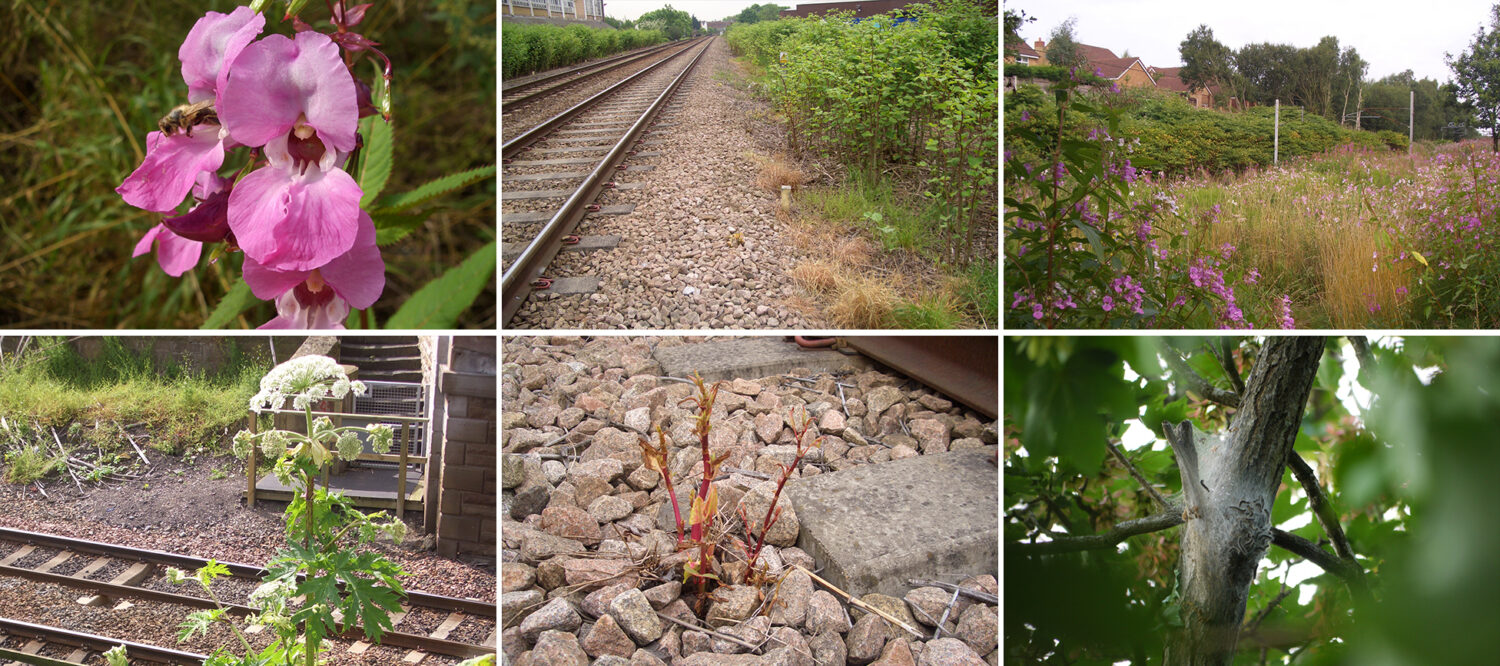
- Japanese knotweed.
- Himalayan balsam.
- Giant hogweed.
Other species in Part II of Schedule 9 of the Wildlife and Countryside Act 1981
Treatment methods (plants)
Manual – follow guidance from your region or route environment specialists. It may be possible to cut back the growth if it is safe to do so and will not increase the likelihood of the plant being spread further. If this is done with Himalayan balsam before the plant flowers, this can significantly improve the chance of control.
Chemical – obtain guidance from a BASIS approved person for guidance on the type and dose of herbicide required. Details of the chemicals approved for use on Network Rail estate are found in the Herbicide Protocol.
Biocontrol – seek advice from your region or route environment specialists as there are opportunities for biocontrol of some plants, but they are in the demonstration / trial stages.
Mechanical – these methods should not be used as they risk breaking the law by causing spread of the plants.
There’s also wildlife to consider:
- Yellow-legged (Asian) hornet
- Report sightings as quickly as possible, ideally with photographs if safe to take, and location details, so that the record can be checked and any necessary action taken. Please do not disturb or provoke an active hornet’s nest. Email alertnonnative@ceh.ac.uk
- Oak processionary moth
- Do not start work on a suspected tree until all OPM eggs, nests and caterpillars have been removed and destroyed
- Report any suspected sightings immediately and stop work when safe to do so- email opm@forestrycommission.gov.uk
- For further information, please see the Oak Processionary Moth decision flowchart on the Guidance notes and technical manuals page.
A list of other species in Part 1 of Schedule 9 of the Wildlife and Countryside Act 1981
Treatment methods (animals / insects)
Seek specialist advice for control via your region or route environment specialists. There are some opportunities for biocontrol of oak processionary moth caterpillars.
Biosecurity
Remember that the reason many of these species are invasive is because humans have introduced them in to a different environment. Plants like Japanese knotweed can grow from tiny pieces of plant material. These can easily be carried on machines and tools – be aware of biosecurity protocols to keep equipment, machines and PPE clean.
For further information on Japanese knotweed please see the Japanese knotweed guidance note on the Guidance notes and technical manuals page.